This sixth installment of #WeRideTogether’s Boundaries Series reviews Circles of Control, offering an activity that serves as a useful mindfulness tool to help us manage our emotional reactions to stressful situations, visualize our boundaries, and refocus our energy on what we can change rather than what we can't.
It may be helpful to review The Basics, which covers the basic tenets of holding boundaries (as well as why we need them in sporting environments), The “Let Them” Theory, which highlights a tool anyone can use to begin working on setting and holding boundaries, How Do You Take Your Coffee, which gives a metaphor on ways to communicate your boundaries, “Boundary Circles,” which provides a visual framework for setting boundaries, and The Mentor Model, which provides actionable steps you can take in your sporting environment to develop healthy relationships.
My mom likes to say, “I can control a lot of things, but I can’t control the weather.”
While it would be great to have the power to generate perfect weather conditions every day, we sadly have to accept that the weather is completely beyond our control.
However, it’s hard not to worry about things, even the things over which we have zero control. I also can’t control the weather, but that didn’t stop me from staying awake for hours before my first half-marathon, worrying about how the forecast rain would affect my performance. But what actually impacted my running was the lack of sleep due to expending my energy stressing about the weather.
Even though it sometimes feels impossible to control our worries, there are tools we can use to sort through our anxieties and help us understand what we should be focusing on instead.
What are the Circles of Control?
The “Circles of Control” theory was popularized by Stephen Covey, but has been used as a philosophical framework for thousands of years. The Greek Stoic philosopher, Epictetus, wrote, “Some things are within our power, while others are not. Within our power are opinion, motivation, desire, aversion… not within our power are our body, our property, reputation, status.1
Essentially, the things that lie within our control are the things on which we should focus our energy and work to improve, and by contrast, some things lie outside of our control that we shouldn’t spend too much time worrying about, because we can’t directly change them.
The “circle of control is a useful cognitive tool for individuals to manage their emotional reactions to stressful situations.”2 It is a mental wellness framework and tool that is usually divided into three circles:
- Things I can control (inner circle)
- Things I can influence (middle circle)
- Things I can’t control (outer circle)
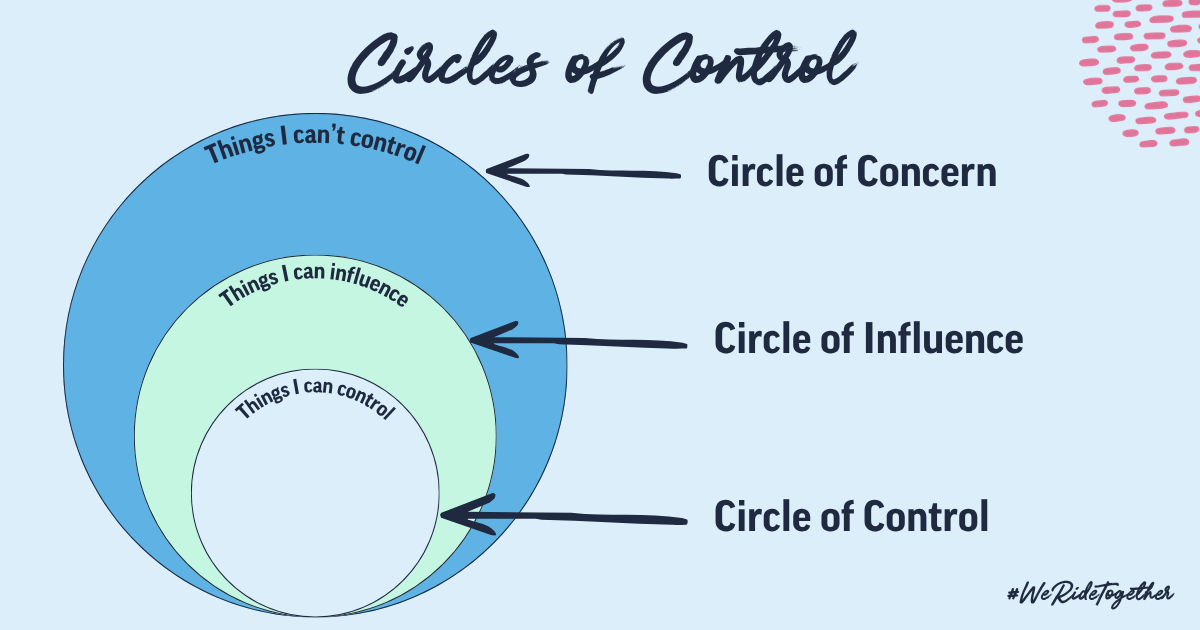
The Circle of Control
The innermost circle is the circle of things we can control and directly impact.3 For example, if our team loses a big game, we can control how we react and the sportsmanship we display.
This circle may also include things like our:
- Boundaries
- Emotions
- Thoughts
- Self-care practices
- Routines
- Personal goals
- Environmental preparedness (like staying hydrated on a hot day, or wearing an extra layer when it’s cold outside)
- Reactions to different situations
- Words
- Priorities
Our Circle of Control encompasses the things on which we should focus most of our energy and work to improve, because these are the areas where we have genuine agency and autonomy. It represents all of the areas where we can take meaningful action, create change, and make a positive difference.4 Even small changes that we make within this circle can have a big impact on our lives.5
The Circle of Influence
The middle circle is the circle of things we can influence. This is where our inner circle meets the outer circle and represents “the intersection of factors within our immediate control and those that fall outside of our area of control.”6 Decisions we make in our inner circle can impact events outside it.
For example, we can choose to give it our all at practice every day to improve our skills, and we can choose to help our teammates improve their own skills. This dedication to training has the potential to result in winning games. But there is always the possibility of losing. So, by practicing, we can influence our probability of winning, but we can never directly control the outcome of a game.
Other things we can’t fully control but can influence include things such as:
- Team dynamics
- Relationship dynamics (friends, family, teammates, coaches, etc.)
- Preparations for upcoming challenges
- Winning or losing a game
- Setting an example to inspire change
It is important that we manage our expectations around our Circle of Influence. We can’t control whether or not our teammate might be receptive to feedback about their technique or how they play the game, but we can influence that conversation by choosing our timing and approaching them with thoughtfulness and care. Recognizing this can reduce our frustration and help us direct and use our energy in a more effective way.7
The Circle of Concern
The outermost circle is considered to be our “Circle of Concern”. This circle encompasses a wide range of external challenges and situations that we might care about, worry about, and focus our energy on, but cannot control, no matter what we say or do.8
The things inside our Circle of Concern include things such as:
- Other people’s choices
- Other people’s actions, reactions, behaviors, and feelings for us and others
- Things we said or did in the past
- Unexpected life events
- The weather
- The economy
- Traffic
- Accidents
- Illnesses
- Deaths of loved ones and others in our lives
These are things we need to learn to spend minimal energy on or let go of entirely, because we have no way to control or change them. When we spend a lot of time and energy on these things, we end up exhausted, because we’re basically trying to solve issues that aren’t ours to solve.9 Focusing on them too much can also make us feel powerless and like we’re in a constant state of worry, because there is truly no end to the list of things we care about but are outside of our power and control.10
Taking the focus away from these things is much easier said than done, but labeling something as outside our control is a huge step toward relieving our brains.
Our brains are hardwired for problem-solving, so when we let them know, “Hey, this isn’t our problem to solve,” we can focus our attention and energy on problems we can solve.11 This doesn’t mean we stop caring about the things in our Circle of Concern. It’s not a “prescription for detachment.” Rather, it is a “way of focusing our attention and energy on what really matters, so we can live more fully and authentically.”12
Remember, we can’t control the things inside of our Circle of Concern, but we can control our reactions to them and how we move forward.
It is completely normal to still spend a lot of energy worrying about things we cannot control. If you ever notice these feelings, consider engaging in a grounding exercise, breathwork, or using other sensory tools.
Think About Your Circles:
Grab a sheet of paper and something to write with, and try out the circles for yourself. You can either draw your own using the example at the beginning of this article or print our Circles of Control activity.
First, make a list of everything that's currently stressing you out or giving you anxiety, including things in and out of your sport. Once you’ve made your list, sort each item into your Circle of Control, Circle of Influence, and Circle of Concern.
Now that you have your list sorted, you can create an action plan:
Choose one thing from your Circle of Control, and ask yourself, “What are a few small actions I can take in the next week to improve this/reduce my stress around this?”
Start with something small. It could be sending an email, practicing a technique or skill you haven’t fully grasped yet, or prepping for the game this week.
Remember, shifting our focus and energy away from what we can’t control and refocusing on what we can control can take time. But doing this exercise and labeling our worries is a big first step.
Using Your Tools:
As athletes and coaches, we can use our circles in the moment to visualize our boundaries and figure out how to respond in different situations. Read the following three examples to see how we can use our Circles of Control tool in our sport.
Example 1:
Roy is a striker on the varsity soccer team. At a major game against their biggest rival, Roy misses a goal right before the end of the game, and his team ends up losing 2-1. Roy is incredibly frustrated and wants to storm off the pitch rather than line up to shake hands with the other team.
Before he does this, Roy takes a moment to think about what’s inside and outside of his control.
He cannot control the skill and game play of the other team. Roy can influence the game by the way that he plays, but ultimately cannot control the outcome. While he cannot control his teammates' thoughts, actions, and feelings, he can control his own and set an example by showing good sportsmanship, not focusing on the loss, and working hard in future practices.
Example 2:
Isa and Carla are tennis doubles partners. They’ve been working really hard with their coach to get ready for the upcoming state championship. One day at the end of practice, their coach tells Isa that she needs to stay behind for some one-on-one training to improve Isa’s serve. He tells Carla that her serve is great and that she shouldn’t stick around. Carla immediately feels uncomfortable. Isa agrees to stay behind, but Carla notices that Isa looks nervous because one-on-one interactions between athletes and coaches are not permitted
Carla can’t control the coach's failure to follow prevention best practices, or Isa’s response or reaction to the situation. But Carla can control her own actions. She decides to intervene for the safety of her friend and says to Isa, “Hey, my mom said she was taking us out to dinner, remember? We have a reservation in like 15 minutes. Sorry, Coach, but we both have to go.” After they leave, Carla can ask Isa if she’s ok and whether she wants to tell anyone about what happened.
Example 3:
Jennifer is the head coach of the university color guard team, and they are just a week away from their biggest competition of the season. Jennifer begins to get frustrated with the team because they keep making mistakes with the formations. Jennifer gets particularly frustrated with one member of the team, Kelly, because she is not hitting the correct formations, and she keeps dropping her flag.
Jennifer wants to reprimand Kelly for repeatedly making mistakes, but she understands that her team is under a lot of pressure. She wants to encourage them to do well, rather than bring them down. She can’t control Kelly’s actions, but she can provide support. During a hydration break, Jennifer pulls Kelly aside and asks if everything is okay. Kelly tells Jennifer that she doesn’t want to let the team down, but she just doesn’t understand the formations and choreography. When practice resumes, Jennifer decides to break down the routine for everyone, explaining the counts and taking it slow to make sure everyone understands. By the next practice, the team performs the routine almost perfectly.
There is a lot we do not have control over in the world and in our sport.
But there is a lot we do have control over and can influence, which can impact our moods, circumstances, and sporting environment for the better.
Safe and healthy sporting environments pave the way for better performance, better team dynamics, and more fun overall.
If you or someone you know needs support, please visit our resources and crisis resources.
Elizabeth Romary, MSc
Communications Manager at #WeRideTogether
eromary@weridetogether.today
Footnotes
- Epictetus, 2009
- Rohleder and Chen, 2013
- Vallejo, 2022
- Schaffner, 2023
- Alaska Behavioral Health, 2025
- Schaffner, 2023
- Alaska Behavioral Health, 2025
- Vallejo, 2022
- Alaska Behavioral Health, 2025
- Vallejo, 2022
- Alaska Behavioral Health, 2025
- Irvine, 2009
References
- Alaska Behavioral Health. (2025). Managing Anxiety with the Circle of Control. https://alaskabehavioralhealth.org/managing-anxiety-with-the-circle-of-control/
- Epictetus. (2009). Enchiridion. In G. Long (Ed.), The discourses of Epictetus: With the Enchiridion and fragments (E. Carter, Trans., pp. 135–147). Oxford University Press.
- Irvine, W. B. (2009). A guide to the good life: The ancient art of stoic joy. Oxford University Press.
- Rohleder, N., & Chen, E. (2013). Stress and inflammation in experiencing socioeconomic disadvantage. Biological Psychology, 93(2), 248–256.
- Schaffner, A. K. (2023). Understanding the Circles of Control, Influence, & Concern. Positive Psychology. https://positivepsychology.com/circles-of-influence/
- Vallejo, M. (2022). What is the Circle of Control? Mental Health Center Kids. https://mentalhealthcenterkids.com/blogs/articles/what-is-the-circle-of-control