What happens after someone makes a report is an essential component of a safe sporting environment. When a victim/survivor, athlete, parent, coach, staff member, etc., makes a report, the organization must respond appropriately.
Each organization is unique and has different resources, staff, jurisdictional requirements, and reporting policies and procedures. Therefore, case management will vary for Safeguarding Officers tasked with responding to reports.
No two reports are the same. Regardless of the circumstances, reports should be handled in a timely, consistent, and authorized manner. This is the structured case management process. Additionally, reports should be handled compassionately and prioritize athlete safety and well-being. Poor case management can quickly erode trust in the organization, in safeguarding, and in the sporting community.
Best practices for case management:
- Start with Safety
- Base protective measures on safety and risk — not on assumptions regarding guilt or innocence. The goal is to prevent further harm while the response processes take place.
- Is someone currently unsafe? Are emergency services needed?
- Are minors or vulnerable individuals involved?
- Does the accused person have continued access to the athlete or other participants?
- Does the report trigger mandatory reporting or another external reporting obligation?
- Are interim measures needed while the matter is assessed and investigated?
- Know Reporting Obligations
- Policies and procedures should clearly indicate which reports have applicable reporting obligations. Safeguarding Officers should know in advance which reports must be referred to law enforcement or other regulatory bodies, such as the U.S. Center for SafeSport. A sporting organization's case management processes and investigations should not interfere with or replace legally required measures.
- Act Promptly and Critically
- Reports should be responded to promptly in the best interest and safety of all parties. However, haste should not override critical assessment of risk and investigatory processes.
- Have Strong Documentation
- Records should be factual, objective, and secure. Documentation should capture the what, the when, the actions taken, the decisions made, the referrals, the communications, the protective measures, the investigatory steps, the outcomes, and the rationale. Documentation creates continuity, supports accountability, and facilitates learning from history and patterns.
- Have Transparent Communication
- Trauma-informed communication is about reducing unnecessary uncertainty and treating all parties with dignity. Follow confidentiality and procedural requirements when communicating any updates, delays, and available support. Parties should know who their point of contact is. Ensure accessibility and reasonable adjustments are made.
- Know De-escalation Techniques
- Safeguarding Officers should use de-escalation techniques when individuals are experiencing distress to help calm the situation. Re-focus on the person, rather than resolving or discussing the complaint further in heated moments. Display calm and confidence in body language and your voice, written or verbal. Be respectful and empathetic toward the person’s feelings, validate their emotions, and ask questions to understand what they're feeling about. Reiterate that your role is to gather information and communicate information. Prioritize your physical safety and stop the conversation if necessary.
- Maintain Confidentiality
- Confidentiality is about protecting people and processes, not protecting the organization’s reputation, hiding wrongdoing, or discouraging someone from seeking support or justice. Safeguarding Officers should share information on a need-to-know basis, in accordance with the law and organizational policy.
- Avoid Conflicts of Interest
- Organizations must have a clear process for identifying conflicts of interest and protocols for reassigning cases. For example, a conflict may exist if the Safeguarding Officer is a close friend of the coach, or if a board member is a parent of an athlete.
- Provide Supporting Resources
- Support for the parties involved should not depend on the outcome of the investigation. Safeguarding Officers should consider what support may be helpful to those involved, such as counseling, advocacy, and medical care. Organizations should also consider how continued participation in sport can be safe and accessible. Case management can be procedurally fair and survivor-centered.
- Implement Anti-Retaliation Protections
- Safeguarding Officers should consider the risk of retaliation initially, throughout, and after the case management process. For example, athletes may fear losing playing time, or coaches may worry about their employment. Organizations should monitor concerns and respond appropriately.
- Learned Lessons
- Case closure should occur when all required actions have been taken, parties have been notified, documentation is complete, and ongoing safety or monitoring is assigned. Organizations should use de-identified reports to inform risk management, identifying trends and opportunities for prevention.
Informal vs. Formal Approaches to Case Management
All reports should be addressed. But not every report may warrant a formal approach. Taking an informal approach does not mean standards are lower; however, it may be preferred because it can be a short, effective process that ensures all parties are heard and supported. Informal approaches can aid Safeguarding Officers to have clear conversations and set expectations quickly.
Informal approaches may be appropriate for: one-time low-risk incidents, disrespectful behaviors, interpersonal differences, poor conduct between athletes, unintentional breaches of a code of conduct, or when the complainant requests an informal resolution.
Note: informal approaches are not suitable for high-risk situations, incidents of abuse, grooming misconduct, incidents that require mandated reporting, safety risks, discrimination, unlawful conduct, multiple perpetrators or multiple victims, conflicts of interest, abuses of power, power imbalances, or retaliation, even if the complainant requests an informal resolution.
Informal approaches can help prevent unnecessary escalation, enable parties and organizations to learn and make positive changes, and promote a positive culture around reporting.
Formal Guidance for Safeguarding Officer(s) Handling Reports and Investigations
Formal approaches are best when there is high risk to safety and harm. The following guidelines offer specific guidance for each step of the case management process:
Report Intake
The Safeguarding Officer must: (1) ensure that the organization has a dedicated safeguarding email address and a secure database; (2) review the safeguarding email inbox and database daily; (3) respond to emails and reports that come into the safeguarding inbox in a timely manner and in no instance more than 24 hours after an email or report comes in.
Investigations
When appropriate and not in conflict with any concurrent investigations by law enforcement, Safeguarding Officers must conduct an impartial and confidential investigation into reported allegations of misconduct, which includes an assessment of the allegations raised and a determination of next steps.
A thorough investigation requires, at a minimum:
- witness interviews;
- a diligent review of relevant documentation;
- credibility determinations;
- a record of factual findings;
- an assessment of reporting obligations;
- disciplinary recommendations (see below for suggested disciplinary action). (In some instances, where the situation is more complex or involves a major stakeholder in the club, the Safeguarding Officer, together with the club, should consider engaging outside counsel to perform the investigation.)
Below are several steps that are essential to conducting an investigation with the highest integrity.
Investigating allegations: Upon receiving a report of misconduct, the Safeguarding Officer should:
- Implement any protocols to ensure the safety and well-being of the parties involved, as well as the confidentiality of the matter.
- Implement any temporary or interim safety measures as needed, particularly as directed to anyone accused of engaging in misconduct. These measures should be communicated expeditiously and spelled out in writing to ensure no misunderstanding around the requirements and expectations. Below is an example of a suggested communication:
Re: “Notice of Temporary Measures – Urgent – HIGHLY CONFIDENTIAL”
It has come to our attention that you may have engaged in serious misconduct that does not align with the values or mission of our club. While an investigation takes place, we are imposing the following temporary measures:
No contact: You are prohibited from having any contact, whether in person, via telephone, on digital platform(s), or any other means, with any club athletes, coaches, or other personnel. To be clear, you may not contact anyone at the club for any reason (except as to any questions you have about this email, which is noted below).
Temporary suspension: You are hereby suspended from your duties at the club until further notice. You are not to appear in person or otherwise at the club, the gym, the court, or any tournaments or competitions where the club may be playing.
If you have any questions, please direct them to the Safeguarding Officer only. These temporary measures will hereby be imposed and remain in effect until we advise otherwise. The club reserves any and all rights to take any further employment or disciplinary action in the club’s sole discretion.
- Conduct an initial assessment of the written or verbal report.
- Speak with the parties involved, including any witnesses. When speaking with parties and witnesses, the Safeguarding Officer should listen intently, provide time and space for each individual to provide relevant information, reassure any reporter that they did the right thing by coming forward, and exercise caution and sensitivity when advising on next steps, particularly around confidentiality.
Taking disciplinary action: After assessing the report, documents, and party/witness interviews, the Safeguarding Officer will be empowered to assess what, if any, disciplinary measures to impose, up to and including termination or removal from participation in sport. This is at the discretion of the Safeguarding Officer and will be binding on all parties involved (as set forth in the organization’s Safeguarding Policy). In all instances, the health, well-being, and safety of the involved athlete(s) should guide the Safeguarding Officer's decision-making, and where there is any doubt, deference should be given to the athlete.
Cadence and Conclusion of an Investigation
An investigation should be conducted swiftly. All direct parties should be kept apprised of the progress of the matter, as is reasonable and without compromising the integrity of the investigation or violating the confidentiality of the parties involved. The Safeguarding Officer should keep a file marked “Highly Confidential” with a log of all reported incidents, including the date and time of the report, the notes of the investigation, the outcome, and the length of time of the investigation before resolution. As a best practice, any investigation should be concluded within three months from receipt of the initial complaint.
General Outcomes
Generally, there are four kinds of outcomes for reports made to Safeguarding Officers.
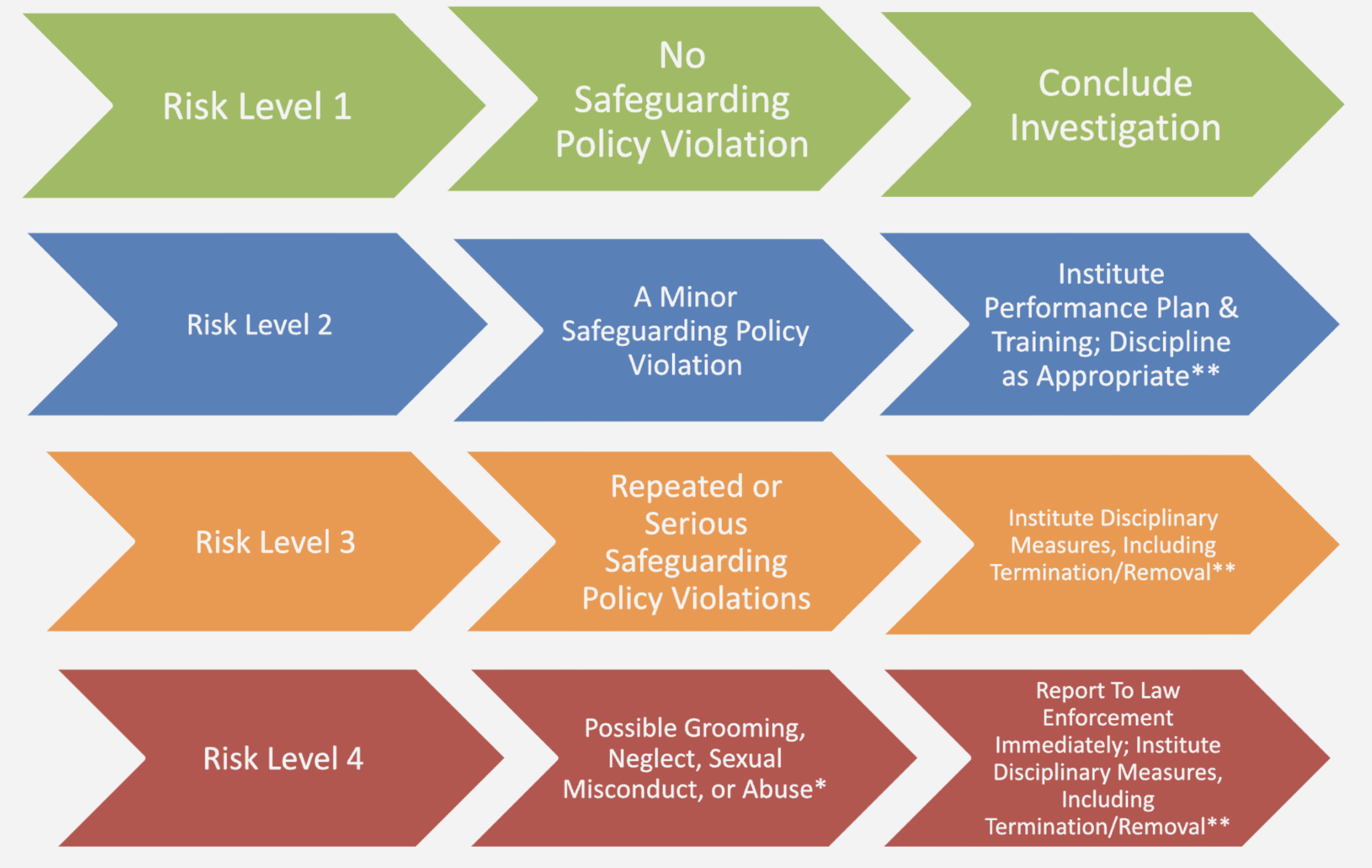
*A reminder that these are for matters that have not otherwise been reported to law enforcement or another investigatory body such as the U.S. Center for SafeSport.
** Depending on the nature and severity of the violations, the following sanctions may be contemplated:
- Written or verbal apology;
- Formal warning;
- Fine or restitution (context-dependent);
- Probation;
- Training and/or supervision;
- Temporary suspension;
- Termination of participation with the organization (i.e., coaching, working, playing, volunteering, spectating, etc.); and
- Any other sanction that the organization deems warranted or appropriate.
Conflicts
If the Safeguarding Officer has a conflict of interest for any reason, whether actual or perceived, the deputy (alongside the club, where appropriate) must designate a third party to conduct the investigation. If the Safeguarding Officer fails to recuse themselves when an actual or perceived conflict exists, they can be subject to disciplinary action, up to and including termination.
For further free education, visit the:
- Play By the Rules Handling Complaints in Community Sport course provided by Sports Integrity Australia.
- Safeguarding Practice and Effective Safeguarding courses provided by the International Safeguards for Children in Sport.
#WeRideTogether provides pro bono consultation services for any organization with specific safeguarding needs or concerns. If your organization or Safeguarding Officer needs support with case management, reach out to info@weridetogether.today for free guidance and resources.
If you or someone you know needs support, visit our crisis resources.
Kathryn McClain, MSW, MBA
Program and Partnerships Director at #WeRideTogether
kmcclain@weridetogether.today
Legal Disclaimer
#WeRideTogether provides general information that is intended to guide parties as to safeguarding best practices. We endeavor to keep our information current and up-to-date, but there is no guarantee of accuracy or that the information is complete. #WeRideTogether strongly encourages you to independently research and verify the information and to generate your own content. The information does not constitute legal advice. In this regard, you should not rely on any statements or representations made on this website or any third-party Internet sites referenced herein for legal advice or for any other purposes, and should consult an independent attorney for legal advice. #WeRideTogether does not assume any responsibility for actions or non-actions taken by people who have visited this site, and no one shall be entitled to a claim of any nature based on the information provided on this site, whether expressly, impliedly, or otherwise.