
If you needed brain surgery, would you ask your family medicine doctor to operate?
In a #WeRideTogether roundtable discussion, attorney Doug Fierberg explains that choosing a lawyer is much like choosing a physician. Just as a neurosurgeon is the right specialist for brain surgery, Fierberg notes that only certain lawyers are equipped to guide clients through sexual abuse, sexual assault, and grooming-related cases (#WeRideTogether, 2025).
If you are a survivor or witness engaging with the legal system and you are considering legal representation, this guide is for you.
Do I Even Need a Lawyer?
Finding the right lawyer is the second step. The first step is deciding whether legal representation is something you need. As a survivor or witness engaging with the legal system, you may receive mixed messages as you make this decision.
Although it is not always required, best practice is as follows: if you are able, retain a lawyer.
The legal system is a maze, and it’s one that nobody anticipates having to navigate—until they have to. Legal language alone is exclusionary to anyone who hasn’t studied the law. A lawyer can guide you through this intimidating process, translating the complexities of the law into plain language to ensure that you are informed every step of the way. There will be countless decisions to make at each stage, and having a professional in your corner as your advocate and sounding board can make those choices far less overwhelming.
If you are pursuing a civil lawsuit, you will typically need legal representation. Your lawyer will investigate your claim, file the lawsuit, build your case, negotiate with the opposing party, and represent you if your case proceeds to trial. They will also manage the discovery process, which involves gathering evidence, requesting records, and communicating with the other side.
If you are involved in a criminal case, it is important to know that the attorney prosecuting your case represents the government. In other words, the lawyer pursuing your case is not your lawyer (Rowland, 1992). However, it is within your rights to find a separate attorney to represent you throughout this process. There is no obligation for you to do so, but having a professional on your side can be immensely helpful. A personal lawyer will act solely in your best interest, advocate on your behalf, keep you informed, and protect your rights.
If you are involved in a Title IX or SafeSport investigation, it is not required that you have legal representation. However, these proceedings can be incredibly complex and taxing. Having an attorney to help you navigate the process can be immensely valuable.
Resolution sometimes involves several of these pathways, as these systems are not mutually exclusive. Depending on the situation, you may be able to pursue multiple of the above options. For more information, see our Justice Options for Athletes blog post.
The financial burden is a major factor in deciding whether or not to retain a lawyer. However, as we discuss later, there are many options that can reduce or even eliminate economic barriers to seeking legal support.
How to Find the Right Lawyer for You
Once you have decided to seek legal representation, it’s not always clear where to begin. Referrals from victim advocates, therapists, or other attorneys can be an excellent starting point. But if you don’t have a referral, there are many other places to look.
- National Crime Victim Bar Association (Civil attorneys)
- National Crime Victim Law Institute (Criminal case resources)
- State or local bar association lawyer referral services (Referrals for any case type)
As you conduct your search, visiting an attorney’s webpage can often give you an informative overview of their practice. The following are important factors to consider as you browse.
Relevant experience
It is paramount that you find an attorney with experience related to your case. Many well-respected attorneys are excellent negotiators and litigators, but are not well-suited to represent victims of sexual violence. The knowledge, strategy, and sensitivity required to handle cases of this nature are developed through practice.
Trauma-informed
Unfortunately, our legal system does not always operate in a way that is survivor-centered. As a result, some attorneys practice in a manner ill-suited to survivors. When you are browsing attorney websites, look for language that reflects a victim-centered approach. This may include emphasis on listening, collaboration, and empowerment.
Shared values
Justice and resolution can take on many forms. Different survivors have different needs and priorities when it comes to healing. Look for an attorney whose values match your own. Whether your ideal outcome involves financial compensation, reclaiming your story, institutional accountability, safety measures, preventing future harm, or simply being heard, you deserve an advocate who will support your goals.
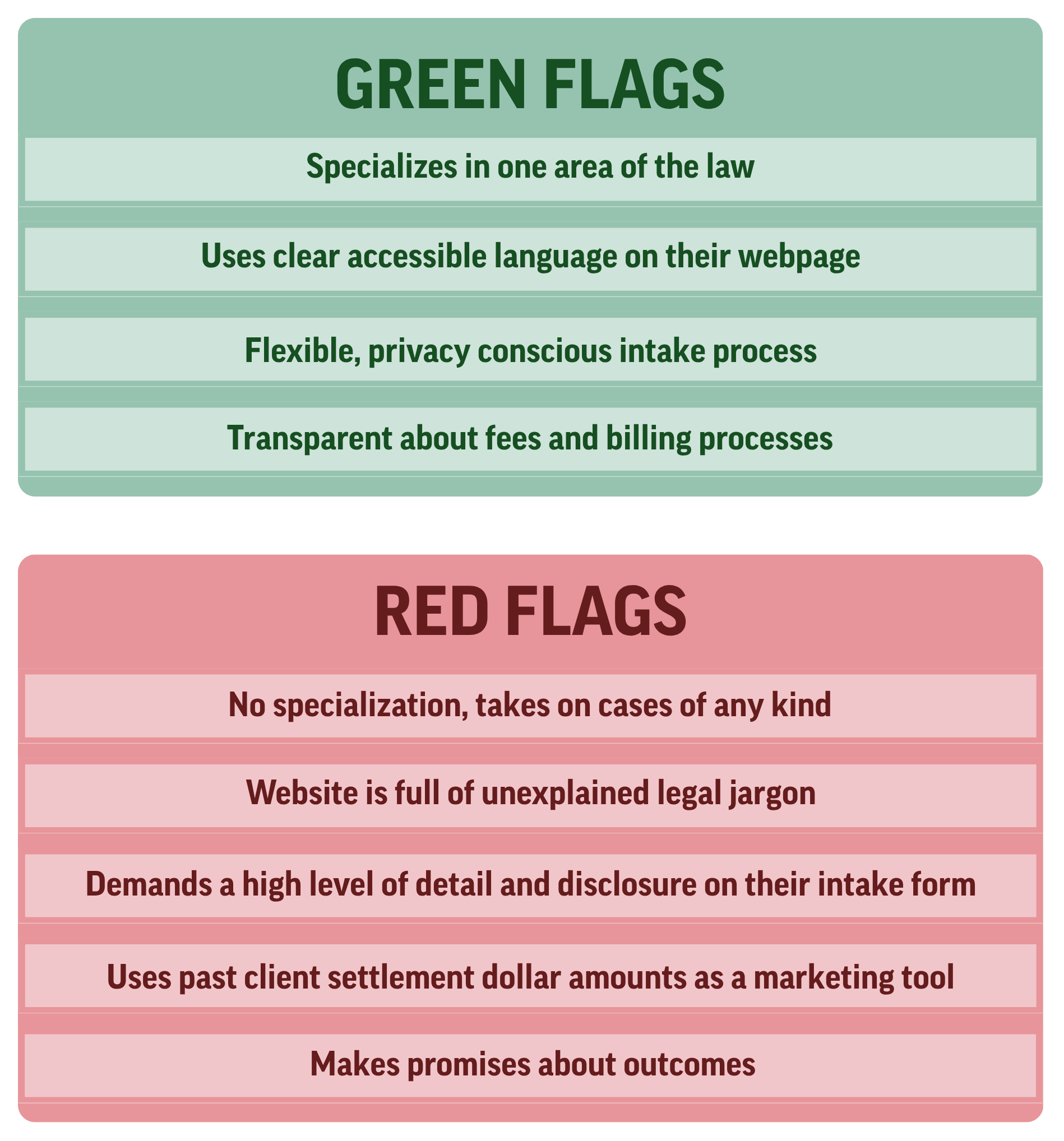
Green and Red Flags
It can be hard to distinguish a good fit from a poor one. No single factor is definitive, but these quick checks can help you identify attorneys worth contacting.
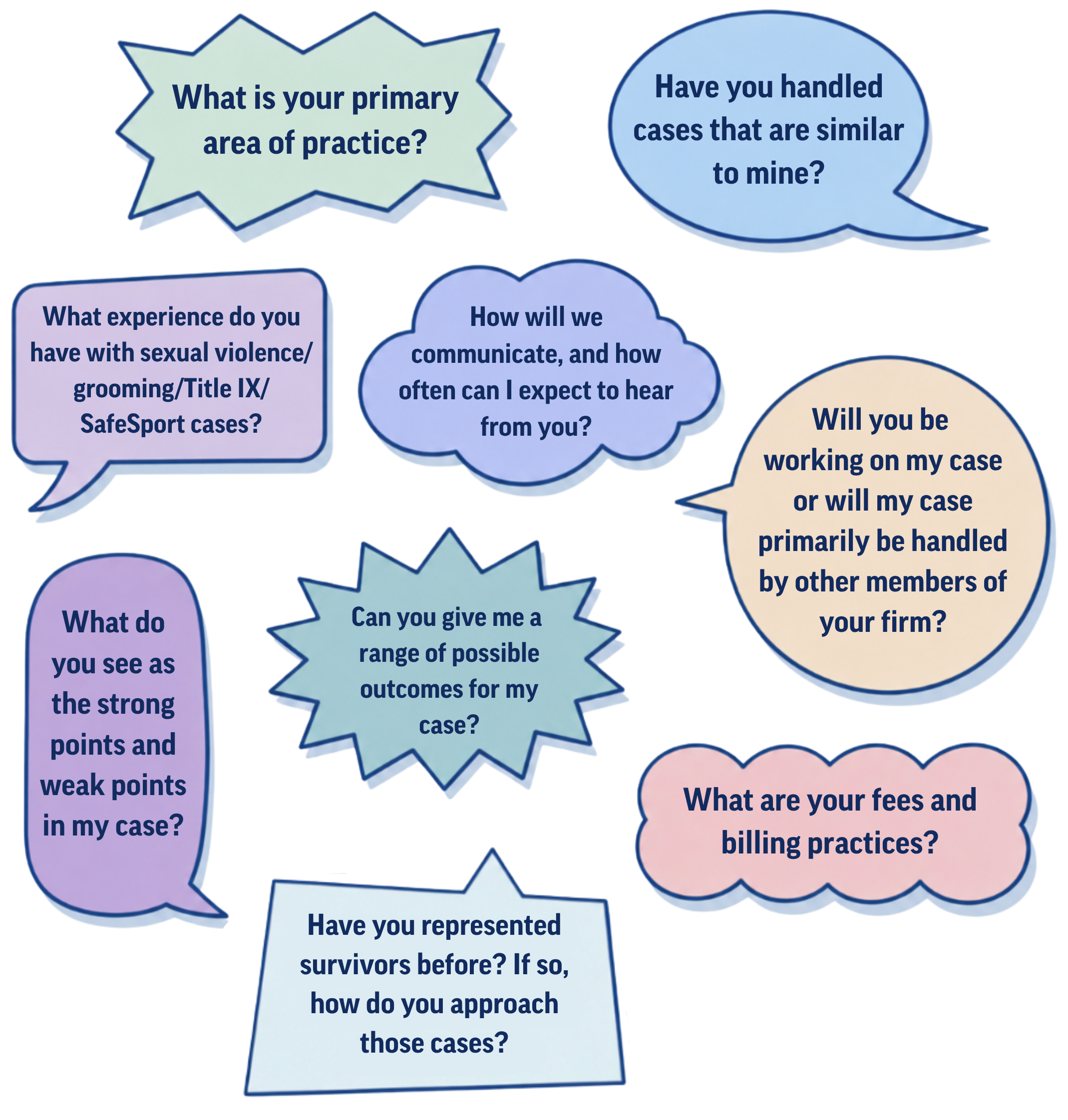
Questions to Ask in a Consultation
Once you've identified a few promising attorneys, schedule a consultation. Before you retain a lawyer, it is important to have a conversation and evaluate the fit. Having questions prepared before your initial meeting can help you confidently and effectively interview your prospective attorney ("Questions to Ask Your Attorney," 2026). Here are some questions to consider asking:
Legal representation can be expensive, but cost need not prevent you from finding legal resources. Just as there are many different ways to pay for healthcare, the legal world offers options that are not strictly out-of-pocket. There are several avenues for reducing legal fees.
Contingency Fee Arrangements: Many civil attorneys offer contingency fee arrangements, where there is no upfront fee for their services. Instead, your lawyer will be paid a percentage of the settlement you receive ("Contingency Fee," 2022). If you do not receive any financial recovery from your case, you typically will not owe your attorney anything.
Pro Bono: “Pro bono” translates to “for the public good.” Many lawyers take on a certain percentage of their cases pro bono, offering their services free of charge. This can apply to lawyers of any specialty. You can ask prospective attorneys if they offer pro bono representation and whether you might be eligible.
Legal Aid: Legal aid organizations are nonprofits that provide low-cost or free legal services. If you meet their income or eligibility requirements, they may be able to assist you or refer you to other low-cost options.
Reimbursement: In some cases, victims may be eligible for reimbursement of certain legal expenses. In some states, crime victim compensation programs may cover legal fees related to your case. In some circumstances, a court may order the defendant to reimburse certain expenses, including legal costs, although this depends on the ruling in your case and the laws in your jurisdiction.
Client Best Practices
Once you have retained a lawyer, be truthful, know your rights, and self-advocate.
You should always be honest with your lawyer. When discussing difficult or uncomfortable topics, being truthful can be hard. However, being forthcoming with your attorney gives them the best chance of helping you. Most communications with your attorney are protected by the attorney-client privilege, meaning that they are confidential. Your lawyer is typically not a mandatory reporter and generally may not disclose your information without your permission (Lareau, 2015).
If you are a survivor involved in a criminal proceeding, you are protected by victims’ rights laws. Becoming familiar with the codes that protect you is important, as it may help you recognize if those rights are breached. The VictimLaw database is a wonderful resource for exploring federal and state-specific victims’ rights laws.
If your case is outside of the scope of the criminal justice system, the rights that apply to you may depend on the state you’re in or the institution overseeing the investigation. Understanding your rights is something your attorney can help with.
Finally, advocate for yourself. You deserve to feel safe and respected throughout this difficult process. If something doesn’t feel right, ask questions. If you believe that your rights are not being honored, raise your concerns with your attorney. And just like in medicine, it is always okay to seek a second opinion.
You Deserve Support
Whether or not you decide to retain a lawyer, you deserve support. The legal system is just one of many paths forward. There are advocates, counselors, victim service providers, and many others ready to help, no matter the path you choose.
Crisis and Support
- The National Sexual Assault Hotline (RAINN)
- Your local rape crisis center
- Suicide and Crisis Lifeline—Call 988
- Crisis Text Line—Text HOME to 741741
Victim Advocacy
Athlete Specific
A lawyer who specializes in sexual violence is often the best person to guide you through the legal system, but there are many forms of support beyond legal representation. There are so many people ready to listen to your story and believe you. Remember, you are never alone.
Emma Borders
Colorado College Student
info@weridetogether.today
Legal Disclaimer
#WeRideTogether provides general information that is intended, but not guaranteed, to be correct and up-to-date. The information is not presented as a source of legal advice. You should not rely, for legal advice, on statements or representations made within this website or by any externally referenced Internet sites. If you need legal advice upon which you intend to rely in the course of your legal affairs, consult a competent, independent attorney. #WeRideTogether does not assume any responsibility for actions or non-actions taken by people who have visited this site, and no one shall be entitled to a claim for detrimental reliance on any information provided or expressed.
References
- #WeRideTogether. (2025, August 18). Roundtable discussion: W.T.F. — Wait, that’s fair? YouTube. https://www.youtube.com/watch?v=o2q304I0hao
- Contingency fee. (2022). In LII / Legal Information Institute. Retrieved August 11, 2026, from https://www.law.cornell.edu/wex/contingency_fee
- Lareau, C. R. (2015). Attorney work product privilege trumps mandated child abuse reporting law: The case of Elijah W. v. Superior Court. International Journal of Law and Psychiatry, 42–43, 43–48. https://doi.org/10.1016/j.ijlp.2015.08.006
- Questions to ask your attorney. (2026). Mnbars.Org. https://mnbars.org/?pg=question-to-ask-attorney---mn-find-a-lawyer
- Rowland, J. (1992). Illusions of justice: Who represents the victim? St. John’s Law Scholarship Repository. https://scholarship.law.stjohns.edu/cgi/viewcontent.cgi?article=1501&context=jcred