If you’ve recently spent time at a swim meet, horse show, rowing regatta, or other sporting event that falls under the umbrella of the USOPC, then you’ve likely seen signage relating to the MAAPP – the U.S. Center for SafeSport’s Minor Athlete Abuse Prevention Policies.
But do you know what it is, or the rules it might require you to follow?
The MAAPP is a set of prevention practices meant to address abuse and misconduct in Olympic & Paralympic sport. It applies to nearly every member of USOPC sport, from elite athletes to grassroots beginners, but many members of our sporting communities are unaware of their rights and responsibilities under this set of rules and procedures. And that’s a problem – violating MAAPP policies can result in sanctions by the Center.
The MAAPP is meant to be implemented alongside the SafeSport Code. The Code outlines prohibited behavior, how to report it, and what the reporting and arbitration processes look like.
The MAAPP is enforced the same way as other SafeSport Code violations, meaning violations of the MAAPP can result in SafeSport sanctions.
According to the Code, “It is a violation of the Code for a Participant to violate any provision of the Minor Athlete Abuse Prevention Policies or other proactive policies adopted by the NGBs.”
The MAAPP applies to Adult Participants in USOPC sport who have Regular Contact with Minor Athletes or authority over Minor Athletes. Adult Participants include coaches, medical staff, trainers, and other individuals in positions of power; they also include Adult Participants who may drive groups of Minor Athletes to practice or competitions, occasionally step in informally as a substitute coach, or practice in close quarters with Minor Athletes.
Best practice is to assume that an Adult Participant has Regular Contact and/or authority over Minor Athletes, and to follow the prevention rules set out in the MAAPP, for everyone’s safety and comfort.
The MAAPP applies to In-Program Contact, meaning contact between a Minor Athlete and an Adult Participant that in any way relates to sport. In-Program Contact includes practice and competitions, as well as activities such as transportation to and from practice, after-competition dinners, team celebrations, or any other contact that could tangentially be related to the sporting environment.
When in doubt, if an Adult Participant knows the Minor Athlete through sport, assume it’s In-Program Contact to err on the side of caution and ensure that safeguarding policies are followed.
To learn more about your rights reporting to the Center if you have experienced abuse or misconduct, read Know Your Rights: What is SafeSport?, a #WeRideTogether resource.
Definitions
Note: The definitions for “National Governing Body” and “Local Affiliated Organization” come from the 2026 SafeSport Code, while the other definitions come from the 2025 Minor Athlete Abuse Prevention Policies.
In-Program Contact: “Any contact (including communications, interactions, or activities) between an Adult Participant and any Minor Athlete(s) related to participation in sport.” This includes sanctioned events such as practices or competitions, but also non-sanctioned events relating to participation in sport, such as post-competition dinners.
Regular Contact: “Ongoing interactions during a 12-month period wherein an Adult Participant is in a role of direct and active engagement with any amateur athlete(s) who is a minor.” Note that the nature of the contact determines whether the contact is regular, not the Adult Participant’s title or role. An Adult Participant could be an amateur athlete with no formal title and still have Regular Contact with a Minor Athlete.
Minor Athlete: An athlete under 18 and/or under-18s who participate as coaches, officials, or in other roles in the sporting environment; under-18s who have participated in sport in the last 12 months.
Adult Participant: A member or license holder of an NGB, LAO, or the USOPC; an employee or board member of an NGB, LAO, or the USOPC; someone within the governance or jurisdiction of an NGB, LAO, or the USOPC; someone authorized, appointed, and/or approved by an NGB, LAO, or the USOPC to have regular contact with Minor Athletes.
Personal Care Assistant (PCA): “Personal Care Assistants (PCA) assist athletes who need help with the activities of daily living or in preparation for athletic participation.” Personal Care Assistants are Adult Participants when they have Regular Contact with minors who are not the minor they care for or are hired by an Organization.
Organization: The US Olympic & Paralympic Committee, National Governing Bodies, and/or Local Affiliated Organizations.
Dual Relationship: “A Dual Relationship exists when an Adult Participant has a relationship with a Minor Athlete that is outside of the sport program.” This could include family members, family friends, medical professionals, or other Dual Relationships. Parents must provide annual written consent for Dual Relationship Exceptions to apply.
National Governing Body (NGB): “An amateur sports organization, a high-performance management organization, or a Paralympic sports organization that is certified by the United States Olympic & Paralympic Committee.” This definition also applies to the USOPC.
Local Affiliated Organization (LAO): “A regional, state or local club or organization that is directly affiliated with an NGB or that is affiliated with an NGB by its direct affiliation with a regional or state affiliate of said NGB.”
Responsibilities and Rights
Individuals and organizations in sporting spaces have responsibilities, rights, and, in some cases, protections under the MAAPP. These can change based on the individual’s age, the amount of power they hold over others in the space, and/or their job, such as being a coach or a medical professional.
One-on-one interactions
Adult Participants & Coaches
Adult Participants are the primary Participants with responsibilities under the MAAPP. Adult Participants must be aware of the standards of behavior expected from them. Coaches are included as Adult Participants, and they have Authority over Minor Athletes.
The number one rule to know for Adult Participants is that interactions with Minor Athletes must be observable and interruptible. That means that someone else can see or join the interaction at any time.
This rule isn’t meant to limit private conversations between a coach and their athlete or make communication more difficult; instead, it serves to proactively prevent misconduct and abuse and help keep interactions safe for all Participants. Instead of having a private conversation in an office with a closed door, it could be held in the middle of an empty riding arena, for example, where other riders who are at the barn could easily walk past.
Observable and interruptible interactions apply to all facets of Adult-Minor interactions unless an exception applies.
Coaches must follow the rule requiring that interactions with Minor Athletes are observable and interruptible unless an exemption applies. This doesn’t mean that a coach can’t have a private conversation with their athlete, or do something like reviewing game footage. It just means that when these situations arise, the conversations should be held with the door open or in another place where they can easily be seen and joined if necessary. Review the “Window Rule” for more information.
In the case of individual training, these situations must still be observable and interruptible. For example, they could take place at a facility where other coaches are training, like public tennis courts, or where other Adult Participants are practicing, like a university swimming pool. For individual training to occur, written consent must be received from parents beforehand. If the coach’s Organization does not collect a consent form, the responsibility falls to the coach. Additionally, consent for individual training can be withdrawn at any time.
Finally, if an Adult Participant learns of suspected or known Child Abuse or Sexual Misconduct, they must report it to both the Center and law enforcement. Reporting to one or the other is not enough to satisfy the reporting requirement. To learn more about your reporting responsibilities, read “What are my SafeSport reporting requirements?”
Parents
Parents who are not also Adult Participants are not technically required to do anything under the MAAPP in most circumstances. However, the Center offers several rights to parents of Minor Athletes through the MAAPP.
Note: Parents who are Adult Participants must adhere to the requirements set for Adult Participants.
Parents are entitled to waive the requirement that one-on-one interactions between their Minor Athlete and an Adult Participant be observable and interruptible if an exception applies.
Exceptions for this requirement exist for Dual Relationships, close-in-age relationships, emergency situations, and Personal Care Assistants. These are not the only situations in which the “observable and interruptible” rule may be waived. See the “Exceptions” section for more information.
Additionally, parental consent is required for individual training to take place. These consent forms must be collected before the training takes place and then annually. The Organization must provide the forms. Parents also have the right to watch individual training sessions.
Minor Athletes
Minor Athletes don’t have many responsibilities under the MAAPP. That makes sense, since the policies are meant to protect them. However, Minor Athletes of an appropriate age should know and understand the safeguarding policies that apply to the adults around them, so that they can know and understand when a behavior isn’t okay. When Minor Athletes are aware of the safeguarding policies that should be in place, they can better advocate for themselves and understand when behavior being exhibited by the adults around them is or is not acceptable, and what protections should be in place for them. Athletes are advised by the Center to check with their coaches to see if the MAAPP applies. If your sport falls under the USOPC umbrella, MAAPP applies.
Interactions between Minor Athletes and Adult Participants must be observable and interruptible. Unless an exception applies, when a Minor Athlete interacts with any Adult Participant, a bystander must be able to easily see or join the interaction. That doesn’t mean that an athlete can’t have a private meeting with their coach; it just means that that meeting must take place with an open door, or in the arena, gym, or another space where it can be seen and interrupted to ensure that no misconduct is taking place. Review the “Window Rule” for more information.
If a Minor Athlete is participating in a one-on-one training session with their coach, it still must be observable and interruptible. It could take place at a facility where other coaches are training, or where Adult Participants are practicing, for example. The parents of the Minor Athlete must be allowed to watch and must give written consent for the training to occur before the training takes place
Health Professionals
One-on-one contact between a healthcare provider and a Minor Athlete must always be observable and interruptible. A second Adult Participant, aside from the Health Professional, must know the treatment is occurring and be within a reasonable distance to see it. Additionally, the Minor Athlete’s parent must be allowed to be in the room during treatment. The only exception to this is an emergency exception.
Recommendations from the Center
In addition to these requirements, the Center has several recommendations relating to one-on-one contact.
First, the Center recommends that there be no out-of-program contact between Adult Participants and Minor Athletes. This means that contact between Adult Participants and Minor Athletes should be strictly sports-related to ensure the relationships remain appropriate.
Second, if an Adult Participant is going to give gifts, they should endeavor to give them to the entire team or as a reward for motivational or educational purposes, not just to one team member.
Third, photos and videos of Minor Athletes should be taken in public and decent.
Finally, Adult Participants should not share or post photos of Minor Athletes.
Online Communications
Adult Participants & Coaches
When communicating with a Minor Athlete digitally, interactions still must be observable & interruptible. If an Adult Participant needs to communicate with a Minor Athlete, they must include either:
- A parent
- Another adult family member
- Another Adult Participant
Even if the Minor Athlete contacts the Adult Participant first, the Adult Participant must include one of these people in the response. Additionally, Adult Participants are encouraged to only communicate with Minor Athletes from the hours of 8am-8pm and not to connect with or follow Minor Athletes on social media.
Parents
When an Adult Participant must communicate with a Minor Athlete, a parent, adult family member, or another Adult Participant must be included in that communication.
Even if the Minor Athlete contacts the Adult Participant first, the Adult Participant’s response must include one of those people.
Minor Athletes
Adult Participants must follow some rules when electronically communicating with Minor Athletes. Namely, if an Adult Participant needs to contact a Minor Athlete for some reason, they must include either:
- A parent
- Another adult family member
- Another Adult Participant
Even if the Minor Athlete contacts the Adult Participant first, the Adult Participant’s response must include one of those people. Adult Participants are also encouraged, though not required, not to have social media connections with Minor Athletes.
Individual Training
Adult Participants & Coaches
As outlined above, one of the major rules Adult Participants must follow is keeping interactions observable and interruptible. This applies to individual training, when a coach is instructing an athlete one-on-one. For example, training could take place on public tennis courts where other Adult Participants are practicing.
Additionally, the parents of the Minor Athlete must be allowed to watch the training session. Consent forms for the training need to be collected either by the Organization or the Adult Participant; if the Organization doesn’t do it, the onus falls on the coach. This must be done before the first individual training session, and each year after.
Parents
Parents must provide consent for one-on-one training to occur. The Organization or coach must provide a consent form, which must be collected annually and before the first training session occurs.
Additionally, parents must be allowed to watch the individual training sessions if they so choose. These interactions between coaches and Minor Athletes must still be observable and interruptible.
Minor Athletes
Minor Athletes are still entitled to observable and interruptible interactions with Adult Participants when they are being trained one-on-one. This doesn’t mean that they can’t be coached individually or have a private meeting with their coach. Instead, it means that training should take place somewhere where other Adult Participants can easily see and interrupt the session if need be, such as a public pool.
Minor Athletes’ parents must also be allowed to watch the individual training sessions if they wish to.
Education & Training
Participants in USOPC sport have some responsibilities to complete annual safeguarding training per MAAPP and the Code. Many Participants will already be familiar with this, as this is the number one way in which the majority of individuals interact with the Center for SafeSport throughout their time in sport.
Adult Participants & Coaches
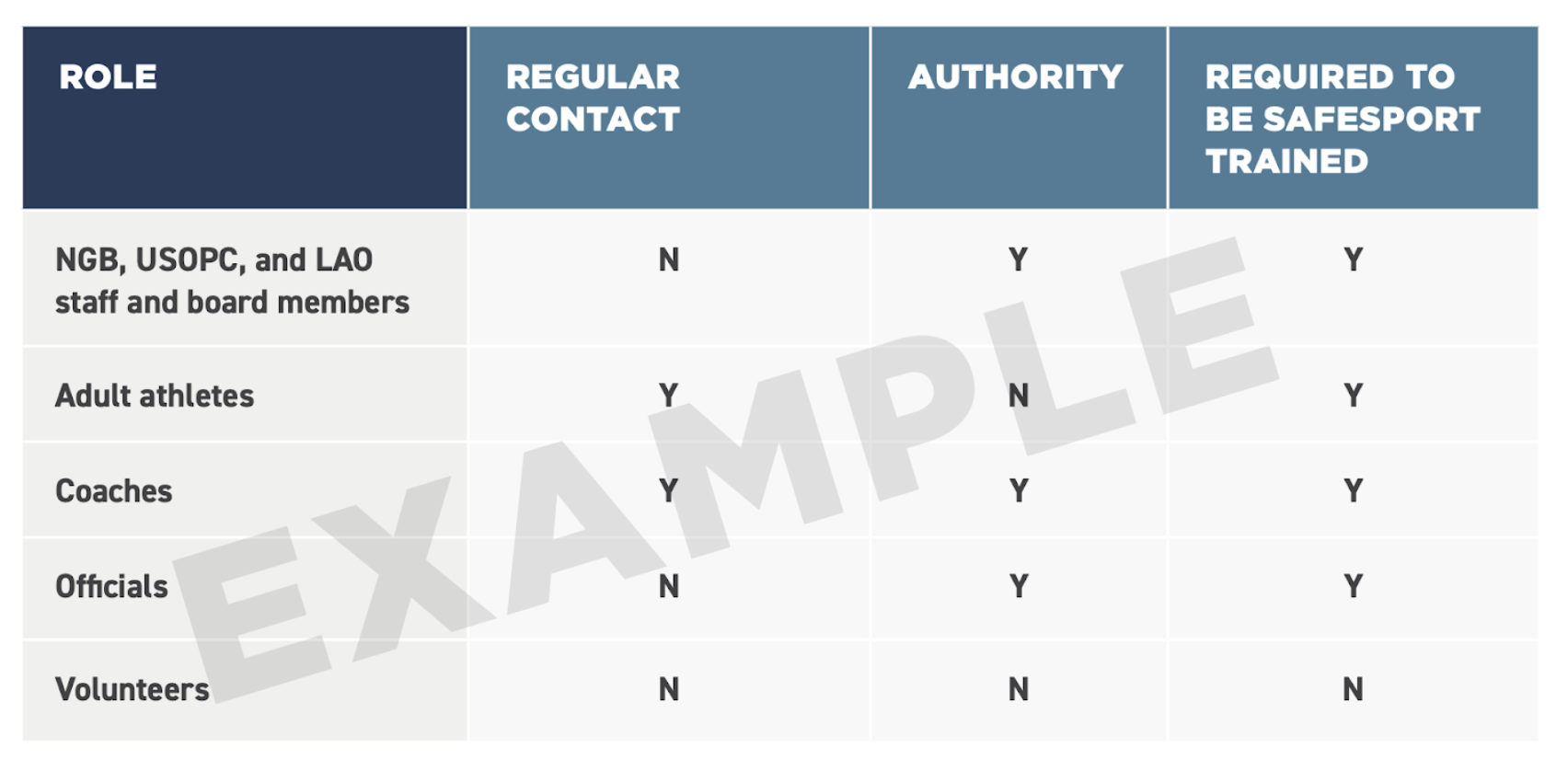
Adult Participants are generally required to complete an annual training commencing from the time they turn 18. If an Adult Participant has Regular Contact with Minor Athletes, Authority over Minor Athletes, or is employed by an Organization, then the annual training requirement applies. This training must be completed within 45 days of joining an Organization or before contact with Minor Athletes, whichever comes first.
The first course that must be taken is the SafeSport Trained Core Course. After the first time this course is completed, it must be retaken every four years. In between, a refresher course must be taken annually.
There are select exemptions for cognitive and/or physical disability, as well as language barrier. Accommodations for disabilities, such as screen readers, are available.
In addition to English, the SafeSport courses are offered in Spanish, French, Mandarin, Russian, German, and Japanese.
Exemptions are reviewed, granted, and tracked by NGBs.
Parents
Organizations are required to offer training to parents every 12 months. Parents are not required to take these courses. However, before signing waivers allowing one-on-one training or travel, for example, parents are strongly encouraged to take the training.
Minor Athletes
Organizations must offer training to Minor Athletes every 12 months, which Minor Athletes can take with parental consent.
Health Professionals
Instead of the SafeSport Trained Core Course, healthcare providers can take the Health Professionals Course. This training must be completed before having contact with Minor Athletes or within 45 days of joining their Organization, whichever comes first. Health professionals still must take the annual refresher course, and can take the Health Professionals or SafeSport Trained Core Course every four years.
Survivors
Survivors may request an exemption from SafeSport Training. Exemptions are indefinite and only need to be requested once, but must be requested by the individual themselves. To request this exemption, survivors must contact exemptions@safesport.org.
Travel & Lodging
Transportation and lodging of Minor Athletes within the scope of sport must follow certain rules regarding observability, interruptibility, and other factors. Furthermore, any Adult Participant who travels overnight with Minor Athletes is presumed to have Authority and therefore must complete the required annual training.
Adult Participants & Coaches
When transporting Minor Athletes, Adult Participants must maintain the requirement that interactions are observable and interruptible. This means that another Adult Participant must go with them, or another Minor Athlete, provided both Minor Athletes are over the age of eight.
If an Adult Participant is going to transport a Minor Athlete alone, parental consent must be obtained beforehand and annually.
If performing room checks, two Adult Participants must do the checks together.
Adult Participants may not room with Minor Athletes. If an exception applies, this rule can be waived, or if advanced parental consent is given in writing for each travel event.
These rules apply to long-term residences as well as short trips, and both planned and unplanned travel.
Parents
If a Minor Athlete is being transported alone by an Adult Participant, written parental consent must be received. This consent must be obtained annually. Otherwise, there must be another Adult Participant or another Minor Athlete traveling with them, so long as both Minor Athletes are over the age of 8.
If Minor Athletes are staying away from home overnight related to their sport, annual consent must be received from parents.
Minor Athletes
When transporting Minor Athletes, the interactions between them and Adult Participants must still be observable and interruptible. This means that if an Adult Participant is driving or transporting a Minor Athlete, there must be another Adult Participant present, or two Minor Athletes over the age of 8. However, parental consent can be obtained for an Adult Participant to transport a Minor Athlete individually. This consent must be received annually at least.
When lodging or housing Minor Athletes, Adult Participants and Minor Athletes may not share a room. Adult Participants who travel with Minor Athletes are assumed to have Authority, and therefore, a power imbalance exists.
If room checks are to be done, two Adult Participants must do them together.
Even long-term residential environments, such as training camps, must meet these requirements.
Even if the travel is not pre-planned, these rules must be followed.
Locker Rooms & Changing Areas
The MAAPP lists several rules relating to locker rooms and changing areas. First, interactions between Adult Participants and Minor Athletes in locker rooms must be observable and interruptible.
Organizations and coaches must provide private or semi-private changing areas at sanctioned events such as practice and competitions. Organizations must also monitor the use of locker rooms regularly and on a random basis at sanctioned events.
If there is to be a celebration or event in a locker room, consent must be obtained and approved by the Organization beforehand. This consent must be documented.
Photos and videos are never allowed in changing areas.
Adult Participants & Coaches
Adult Participants are not permitted to shower with Minor Athletes unless a close-in-age exemption exists or they are wearing swimwear during a pre- or post- activity rinse. However, parents may request that Adult Participants not shower with their Minor Athlete even in these circumstances, and that must be respected.
Additionally, Adult Participants must never expose themselves to or remove their clothes in front of Minor Athletes, even in locker rooms.
Parents
Parents can request that Adult Participants not shower or change with their Minor Athlete. Organizations must respect these requests.
Under the MAAPP, the only time it is acceptable for an Adult Participant to shower with a Minor Athlete is when there is a close-in-age exception or the Adult Participant is “wearing swimwear during a pre- or post- activity rinse.” Parents can request that this not happen either, and Organizations must respect that request.
Minor Athletes
Minor Athletes have certain rights in locker rooms. Organizations and coaches must provide private or semi-private changing areas for Minor Athletes. Additionally, parents are allowed to request that Adult Participants not shower with their Minor Athlete. This request must be respected. Even if parents do not make this request, Adult Participants are only allowed to shower with Minor Athletes “if the Close-in-Age Exception exists, or the Adult Participant is wearing swimwear during a pre- or post- activity rinse.” Adult Participants may never remove their clothes or expose themselves in front of Minor Athletes.
Health Professionals
Observable & Interruptible Interactions
For Adult Participants who are medical professionals, interactions with Minor Athletes must always be observable and interruptible. The only exception that applies to this is the emergency exception. When providing treatment, a second Adult Participant must always be within a reasonable distance to see the treatment happening, and also know that it’s going on. Parents must be allowed in the room as observers.
During the treatment, Minor Athletes must always be fully or partially clothed, and the “breast, buttocks, groin, and genitals” must always be covered. The Adult Participant must explain each step of the treatment and receive consent for each step.
Healthcare providers must notify Organizations when a meeting between them and a Minor Athlete occurs. This protocol must be created and communicated by the Organization. Organizations must also collect consent forms from parents or ensure consent forms are otherwise being collected.
A coach may not give a Minor Athlete a massage or rubdown, even if they are a medical professional.
Education & Training
Instead of the SafeSport Trained Core Course, healthcare providers can take the Health Professionals Course. This training must be completed before having contact with Minor Athletes or within 45 days of joining their Organization, whichever comes first. Health professionals still must take the annual refresher course, and can take the Health Professionals or SafeSport Trained Core Course every four years.
Exceptions
There are a few exceptions allowed for the requirement that interactions between Minor Athletes and Adult Participants be observable and interruptible. Some of them require parental consent, while others acknowledge that emergencies may arise or that a youth athlete who turns 18 immediately becomes an Adult Participant, but may not hold power over their teammates.
Exceptions for Dual Relationships
A “Dual Relationship” occurs when a Minor Athlete and an Adult Participant have a preexisting relationship outside the sporting context, such as being family members, family friends, a teacher-student relationship, or other personal relationships that exist outside athletics.
Parents must provide annual written consent for Dual Relationship exceptions to apply. However, the Organization is entitled to review the consent forms before granting the exception, and the Center encourages them to do so.
Organizations should review the forms with parents to ensure they are giving informed consent and that the Adult Participant understands their safeguarding responsibilities.
Exceptions for close-in-age athletes
When a Minor Athlete turns 18, they immediately become an Adult Participant. However, this may not reflect their actual sporting experience. They may still be in high school, may still participate on a team with younger athletes, have close friendships or relationships with younger athletes, or be classmates and social peers with younger athletes. Immediately treating them as Adult Participants in every regard would limit their ability to participate in sport.
Because of this, a “close-in-age” exception exists. This exception exempts Adult Participants from the requirement that one-on-one interactions with Minor Athletes be observable and interruptible if:
- The Adult Participant is no more than four years older than the Minor Athlete and
- The Adult Participant has no power over the Minor Athlete.
This means that even if the Adult Participant is 19 and the Minor Athlete is 17, if the 19-year-old is a coach, this exception does not apply.
Note that this exception is different from the SafeSport Code’s close-in-age sexual misconduct exception.
Additionally, a parent of a Minor Athlete can request that their child not shower or change with Adult Participants who are close-in-age, and those requests must be respected.
Exceptions for emergencies
Exceptions to the rule that interactions between Adult Participants and Minor Athletes be observable and interruptible also exist for emergencies. Emergencies can occur during inclement weather, due to injury, or other threats to safety. The MAAPP says that an Adult Participant must “carefully consider” whether a situation is classified as an emergency before taking this exception.
The MAAPP also recommends that Organizations create protocols for emergencies, which include documentation, and communicate those with all Participants.
Exception for Personal Care Assistants (PCAs)
Personal Care Assistants provide much specialized care to athletes. Because of this, an exception exists for PCAs. PCAs must meet these standards before the exception applies:
- The Minor Athlete’s parent must provide written consent to the Organization for the PCA to provide care and/or support to the Minor Athlete
- The PCA must complete all required training
- The PCA must meet all screening requirements
PCAs are then able to assist the Minor Athlete they care for in situations that are not observable or interruptible, such as in locker rooms or restrooms, where other Minor Athletes may also be present.
Too Long; Didn't Read
The Minor Athlete Abuse Prevention Policies (MAAPP) are a set of rules governing how Adult Participants interact with and safeguard Minor Athletes in USOPC sport. You may have seen some of their guidelines around a recent competition, such as the requirement that all interactions with a Minor are observable and interruptible, or you may have been subject to the annual training requirement.
The group with the most responsibilities under the MAAPP is Adult Participants, encompassing but not limited to coaches, trainers, medical staff, and amateur adults. Parents have several rights under the MAAPP, especially when it comes to one-on-one interactions between an Adult Participant and their child.
As an Adult Participant, ensure that all your interactions with Minor Athletes are observable and interruptible, including online or digital interactions. If you’re unsure about a policy relating to interactions, travel, locker rooms, healthcare, or other meetings between Adult Participants and Minor Athletes, always double-check the MAAPP.
Understanding your rights and responsibilities under the MAAPP is important because violating the MAAPP is a violation of the SafeSport Code and can result in sanctions. On top of that, it’s important because many of these rules help keep our sports safe, healthy, and fun for all. We all deserve to learn, play, and compete without fear of abuse.
If you have witnessed or experienced a violation of the MAAPP, reports can be made to the Center here.
Madison Smith
Communications Manager at #WeRideTogether
msmith@weridetogether.today